


Lena V. Fedorov,
GI «Theatre Olonho» Respubliki Saha (Yakutia),
Yakut republican public organization "Association Olonkho"
Yakutsk, Россия
C 90-ies of the last century, among the peoples of Siberia began a massive restoration of the traditional rites and sacred complexes heavenly prayers. It began everywhere, and from remote settlements, regional centers, etc.. Например, in villages and towns of Khakassia, Gorny Altai, Buryatia, Tuva and Yakutia observed spontaneous erection of objects of cultural and ethnographic sense, both public, both public and private.
To explain the phenomenon of cultural "resonance" sacred complexes Tengirchilik prayers Siberian Turks, it is necessary to understand the idea of the traditional sky-fire or the sky-dairy rites Siberian Turks - Uriing tunah Ysyakh Sakha, Very Pairam (Overwhelmed, the firstborn) Khakases, Yazhylgan Altai and Dagylga (this Dagыыrы) Tuvan, and others., for whom and organize this complex.
Sakha. Yakut kumysnyh holidays nazyvatsya Ysyakh (yhyah). Yryng sedimentation ysyakh [abundance white food holiday], held after the move to summer camp - sayylyk (hayılık), I had a territorial character (f.1) [7]. During Ysyakh held generic, communal prayer, in some places with devyatiaktovym heavenly ascension - Togus dabatyy (Tair, Prep). The purpose of the ritual – obtaining heavenly blessings and reaching algys during a prayer dance or osuokhay duoha collective initiation by ascension, Fields - tayыы, dayyy the sky, to the supreme god. In the old days this festival organized in turn the head of the genera. In the spring of milking mares first ozherebyativshihsya chetyrehletok and hoarded milk produced in special leather wineskins. During the month the milk oxidized, roamed, and from doing Saamal (haamal) kımıs – clean, the first mare to Ysyakh ritual [4].
In recent years, reviving a sacred holiday function. 21 June officially became the national day national holiday Ysyakh. Holidays are held by the heads of municipal administrations - nasleg, ulus, cities. С 2006 g. The Government conducts an annual global celebration Republican Ysyakh Olonkho (f. 3-5).
Altaitsy. From the report of the generic control clerk 2,3 and 4 Altai dyuchin NA. Kutergina Bijskogo the county police captain about the beliefs of Altai Kalmyks: «… The spring sun looked kindly on the ground; meadows and hills covered with beautiful, fresh herbs; Altaian breath freely; Now he is not afraid to have otzimovok, cow's milk appeared; with the advent of the green and milk, he has long been considered the gods to thank for keeping livestock and requests an extension of his life, the preservation of livestock, as the chief of his wealth; about this, he prays, reading a prayer: GOD tear Altai State ine biik 'e t.d. … Yazhylganu (old god) the victims did not bring cattle, and only one milk and it was then, When spring Kalmyks moved to the summer parking. All the prayers and sacrifices were made kamami…» [5]. 21 June 1904 g. Burkhanist movement activists Chet Chelpanov, his wife Cool Chelpanova, their daughter Chugul Forty etc.. They were arrested during a heavenly prayer. Subsequently, intervened in the case, Professor DA. Klemenz and others., who were arrested in the justification and the accused were released. В частности, Д.А. Clements made on the court with an explanation, Altai is not that a new religion - Buddhism, preaching, do not call the Japanese king, and carry out their traditional native rituals [5].
In Soviet times,, years of collectivization, All Altai clergy heavenly prayers – algyschy and yarlykchi, They have been destroyed. Only they began with the 1990s revival holidays El Oiyn [f. 6-8].
Khakassia. Many of the ancient holiday of Khakass people still exist. One of the most famous festivals - Pyro Thun [Overwhelmed, the firstborn] - Celebration of the first milk. Celebration, extant from time immemorial, It is usually carried out under the open sky in the desert, in early summer, when the first dairy ranchers received in abundance. The first cooking ayran was associated with the arrival of spring, with new green grass, which has absorbed the fresh ground force. In recent years, the holiday has become popular [1].
The main ritual act Khakases Burkhanists consisted in sprinkling ayran and dairy products White Creator - Ah Hood, their main religious supplication is an annual sacrifice to Heaven (Tigir tajii), held in July, on white full moon (filled with terrified). Honoring the Great sky - Khan Tigir represented the main cult Burkhanism Khongor. In the valleys of the Yenisei, Abakan, Chulym, Black and White Iyusov hongrotsy annually spent Heavenly prayer (Tigir tajii), also known as Ah Khuday tayii - ie. White or Sacrifice to God Ulug tayyg – Velikon sacrifice.
At the beginning of the 20th century began to be linked with the prayer on Sunday afternoon. Khakassky term tayyg – proishodit sacrifice from the verb tayы – lift up, podbrasыvaty kachaty. Burkhanist holiday Ah Hood tayii was territorial event, where race did not play any importance. In the days of the Soviet regime began to pursue prayers Burkhanist. Recent Heavenly Sacrifice in Hongorae were committed 1927-1928 гг. on the eve of collectivization. Then religious attributes algyschylov with bronze cauldrons were buried in secret places for centuries [1]. Today in Khakassia restored Tun Pyro holidays. [f. 9-10]
Tuvyntsы. For centuries, from one year to produce a collective prayer Tuva, from which depended on the well-being of their ideas [3]. The life of a single perceived, an endless stream, consisting of two parts: winter (autumn) - Time of death and the summer (spring) - The period of life. After the winter should turn to the spirits for help for the new year. There were more than a dozen such ceremonies and holidays, and they were united under the general name dagylga.
Tuvan consecrated ancestral mountain (Doug), Universe - (Sevilla fainting or delegate), Sky - (On). The most common and mass ritual was Ovaa dagyyry – the altar, which became the beginning of the 1930s, the biggest summer holiday Tuvan. The first rite Ovaa dagyyry performed after moving to the summer parking - Chaylag or after the sowing, when the cattle put on weight [3].
In the late 1930s the rite this dagыыrы It was banned as a nationalist and not further held. Однако, devoid of religious content, it is the second half of the 20th century has become a national holiday Naadym, name taken over from the Mongols. Today Naadym – Tuvan national holiday livestock, which is held annually in mid-August. Naadym tradition of celebrating with renewed 1993 года [3]. Rites Ovaa dagyyry revived in its original form [f. 11-12].
Main heavenly prayer ceremonies performed in Siberia Turks equinoxes and summer solstice, Moving to the summer parking sayylyk (hayılık) - as., chailag tuv. After the October Revolution, holding this ritual holidays pursued across Siberia as nationalist or remnants of the dark past. During the Soviet regime the national holiday was the holiday of a secular nature.
According to the epic materials, ancient Yakuts organized a spring holiday in the foothill valley Ysyakh - Alaas.
In Yakutia, the annuals arranged in the valleys of the mouths of rivers or on the shores of karst lakes. The area of the rite seek diligently, it had to be the place, which was evidenced by the "sacred". Generally, in the foothills of the valley of river mouths, near karst lakes are elevation – Hill, where there were a sprawling birch. Under the hill were stuck round the young birch saplings-chechir, their associated ritual horse Twine salami, and receive enclosed sacred area – to?р??, kure.
Yurts were installed on the north side Alaas, there and set the main ritual Mogul yurt - a model of the world mountain. It was covered with birch bark, considered, that through its upper hole extends through the axis of the universe, It is a place of convergence of the three worlds. It is the archetype of the World Mountain, the top of which rests on the North Star.
Details of the complex tyusyulge: altar for kindling the fire of heaven – xolumtan, World Pillar - Aar bugs, By?brother, distance konovyazyami serge, constructed by sunrise line. World mountain, a model of the universe, Temple - Mogul Urasa yurt was constructed to the north-west side, on the right side of the yurt located koumiss place - t???lge, tyusyulge with hanging on the crossbar of his leather kumysnyh tubs simiir, and a number of konovyazny, symbolizing the way to Heaven - aartyk.
The southeastern part of the complex was open for sunrise viewing, this sacred side, top of the world. World Tree Aar bugs out in the form of nine-speed celestial hitching post – то?Uz tomtor?olooh Toyota serge. According to the beliefs of the Yakuts heavenly grace penetrate to the ground through the Aar bugs. A bug or upper opening of the yurt Mogul Urasa passes universe axis, is a through channel, a place of convergence of the three worlds – Heaven, Earth and Hell.
Through the sunrise from the bugs were constructed of stone altar holumtan. Holumtan - center, altar, which fueled the sacred fire from heaven, meant "otvorenie heavenly doors'. Fire hearth holumtana – archetype, Skyfire symbol, the plasma state of celestial bodies.
On both sides of the bugs were placed sacred Ytyk serge hitching post for tying a sacred animal Ytyk??h?, ıtık lasts - Lectures and Workshops jerebyat protein. They plaited mane and tail colored ribbons Salam, covered with ornate Cheprakov. In old times, indicating the way to heaven algyschyta, serge put nine on each side, denoting the boundaries of nine celestial layers, spheres. The tops of the bugs and every ritual serge joined with string of horsehair with?р??, grayer strung with colorful ribbons on them salaam. This space ordering symbol, nine layers of celestial spheres, and their system due to a common center cross-cutting global pillar (scheme 1).
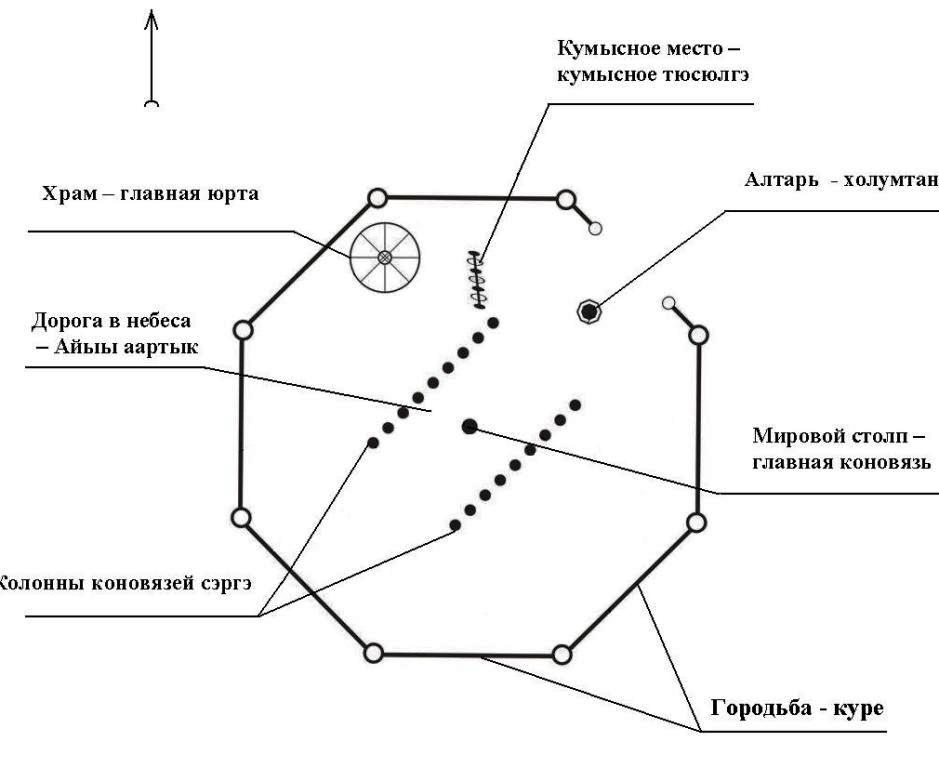
Plan Yakut kuree, tyusyulge scheme 1.
On the picture 13-14 predstavlen complex serge mestnosti Uulaah Ha'thach Ulus Tukathatong Republic of Sakha (Yakutia), which it was held Ysyakh in honor of the Victory in the Great Patriotic War [6].
On the picture 15 Rite algys shown on Ysyakh area Kulusunnaah Tatta region, Soviet time [6].
Khakassia. Across the territory of Khongor, on many mountain tops were built the Temple of Heaven. Large temple complexes known as SET. For example, in the valley of the river Ninh, on the mountain of the same name SET (букв. Mountain-Church) preserved grand structure. Khakassky term, вероятно, goes back to the Old Turkic ushtan - paradise. The bulk of upland structures constitute chapel suma (Syme) Gospel kure (кiрo). Sume is usually used once a year. According Hongorayu there are about a hundred, some mountains, where religious temples built, как, например, chapel at the mouth Tunguzhul, and called Kirё tag - Mountain Cours. And many of them were created in the Kyrgyz times, Long before adding Ah Chayana, and used a second time. Burkhanist syme consisted of the following set. On the hill a place of worship was surrounded by a stone wall, circular or square in plan. In the center was an altar taskhah, laid out from the stone slabs in the shape of a cube. Sometimes used square stones (xır stone). Near the altar necessarily established with rhizome sacred birch share Hazyna, that give light weight ritual ribbons chalama. If you are not on top of the mountain like, the head of the community tos grooves dug out a three-year birch (always with roots), I drove to the ritual site and installed, pulling the roots of stones. After sacrifice it remained in place. It was forbidden to touch. Hongortsy believed in its magical properties [1].
On the heavenly sacrifice near birch share Hazyna-Ground hitching post, which tied the sacred horse - yzyha white suit (ah manganese), which should go White creator - Ah Hood. Its mane and tail were intertwined white and blue ribbons chalama [1].
The head of the community was obliged to bring the slaughter three-year wethers white with black ears or cheeks mara pastyng ah sileke. Black or completely white white (manganese) lambs to sacrifice the sky did not bring. Also the head of the community at the sacrifice of Heaven brought lambs other hongortsy, are obliged to provide financial assistance during prayer. Chapter thanked them and shook hands with everyone. In the ritual celebration to slaughter 20-30 sheep. In place of sacrifice yldyrbe, Again Okura smoke Bogorodskaya grass - Irbene, They tied according to the social rank of the sacred tow rope ax chile, length of seven yards. Twine was fixed at one end of the trunk of the sacred birch share Hazyna, while others clung to the tree standing next [1].
Altaitsy. From the diary of a deacon W. Khabarova for 1908 of: "Religious buildings": «…. Urta tyry standing on Myška high bay foothills, and behind the yurt from this distance on both sides were two other yurts, koi seemed as if placed protection. At the bottom in the spoon stood two other yurts. All family members living here tyry. Through spoons in yards in 200 tože at bay foothills vidnelsâ Kure, cure (place of prayer), we asked tyry, so he drove us there and spoke about the importance kuree, "can, You can talk all you can " – said the amiable Tyry, willingly took on a kuree, where we questioned the value of each tagyla (the altar) and he gladly explained. In the absence of photographic apparatus, we can limit ourselves to the following rough drawing (scheme 2) [5]:
-
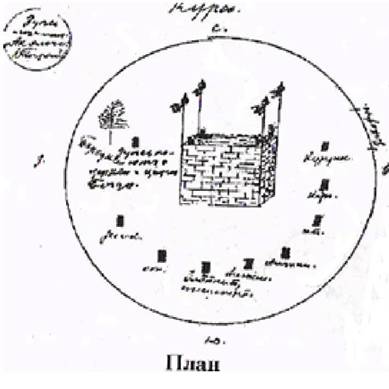
Plan Altai Kure Scheme 2
Circle means of simple fence aspen poles, osymiugolynaya of zherdey.
- In the very middle of the main altar of the fence, the height of about, 2 Arches. and ? Arches. dikago latitude of limestone stone.
- All the little-too altars of stone. As the main altar, and small altars called tagyl, (in the old faith was called the San or shiree) every place of prayer with all tagylami called Kuree. In contrast to the small main altar called Kureenin-fighting. [5].
From M Deacon notes. Yalbacheva (1906 of): "... We have been desirable to examine the altars, some of which make their prayers Burkhanists <…> The first altar is a simple rectangular frame, sheathed with boards, arshins 2,5 или 2 width and arshins 2,5 height. In the corners of the altar four enameled bowls set. On the east side of the altar two poles were set with white and yellow ribbons. In front of the altar stuck four birches, the value of which is as follows: two - the sun, two - the moon. The second altar, similar to the first, only complicated it from wild stones with a hollow in the middle. On this altar of burnt remains of sacrificial zhivotnago. На 10-15 fathoms distance from the altar in a semicircle stuck birches, and in front of birch - small bars, which Burkhanists harness heather " (F.16) [5].
Tuvyntsы. All lighting ceremonies (except from dagyyry - consecration of the hearth) carried out on the mountain, or any hill. On notions of Tuvan spirits inhabit them, from which the well-being of the people depends. Therefore, the cult of the festival was accomplished necessarily at the top. Valley as opposed to the mountain - the place of residence of people with their joys, ʙedami, diseases, Graham. In order not to disturb the spirits, not enraging them by their actions, people spent the final part of the major ceremonies and holidays (sports and a feast) in the valley [3].
On the hill, where committed ceremonies and celebrations, the main character becomes an altar - ovaa. He constructed a hut of twigs of willow and pine trees. To branches are not broke, they tied with ribbons, woven from horsehair. Login ovaa facing the sacred side of the world - eastern (where the sun rises), так же, as well as the entrance to the tent. Long before sunrise aale (camp) going man, We approached the elders of the clan yurt, asking him to carry out the rite. He accepted an invitation, and all the participants, led by the leader began a procession to the altar, located on the top of the mountain.
Elder was worshiped as a living god, endowed with supernatural power - power over the elements, secret knowledge. Chapter kind played the role of mediator between the people of the other world deities. By carefully preparing the rite.
Costume party ritual act were beautiful, new, holiday. Like all rituals, and Tuvan holidays, Ovaa dagyyry started early in the morning, at sunrise. In the final part of most ceremonies and holidays, only men were allowed.
The procession to the altar, made in silence. People climbed to the top to the scene slowly, measured. All were preparing for the sacrament - communion with the spirits. No one spoke, so the expectation signal - early sunrise - was held in silence.
During the reading of good wishes men were standing on the west side of the ceremonial site, facing east, watched the sun come through the center of the site - the altar ovaa. Participants then lined up in a straight line - a sign of equality before the spirits with the exception of the elders, who became the head of the procession, and together they made a triple bypass altar with stops for bows in all directions. From the east side of the sacred. On the eastern side staged the largest of the four sacrificial fires - san Salyr. Young people lighted fires cleaning san Salyr the four cardinal. The culmination of the ceremony - an appeal to the elders of the clan spirits. When the first rays of sun began to read Elder yёreel (good wishes), making thus a ritual action - chazhyg (affusion, natural feeding). After fulfillment of all prescribed tradition of ritual gestures, prostrations and prayers of praise, participants went down into the valley. rite, contest, feast - that has always been committed at once routine and never violates order,ru [3].
Таким образом, spatial organization of ceremonies Tengirchilik prayer was made according to the established canon,ru. On selected areas in some sense being constructed complex of sacred buildings. The basic principle of the organization is one of the complex buildings: gorodba – kuree, world mountain (temple) – ritual yurt, this, World Pillar - hitching post, altar, очаг – altar. Orientation facilities at sunrise.
The idea of ritual prayers – ascent to heaven for divine blessing and sprinkling algys received algys all earthly. Sprinkle Yakut lang. – Ysyakh, Braj – chazhyg, climbing, taking off in the Yakut – Prep, in Khakas - tayii.
The whole composition of the complex – a projection of the vertical plane of the world landscape. The boundary of the projection of the vertical space in the plane designated gorodboy kuree. Horodba IZ Zherdiy chickens - how., gold., Hack., twine horsehair Sitia, Sere - how., ah chile - hak., ribbons Salam - yak., calama - Hack., gold., TUV.;
This ancient rite of the heavenly prayer imprinted on the monument of the fine arts Tagar archaeological culture (X—III в. до н. э.), consisting of two groups of the petroglyphs: Minor and Major Boyar petroglyphs in the south-western part of the ridge Bojary (in that Khakassky Poyar? - "The Holy Mountain"). This low mountain range in 6 км. south of the village of Trinity Bogradsky District Republic of Khakassia, It stretches along the left bank of the Yenisei (F.17).
MA. Devlet: "... The surface of the Major Boyar petroglyphs dotted with scars, scratched, potholes, cut by deep cracks, of which, as seen, It existed even before, like primitive painters applied to their rock drawings. Time has smoothed image, sometimes they are densely overgrown with lichen. Кроме того, Most pisanitsa unprofitable lit.. Obrashtёnnaya south, it is clearly visible only in the evening and early morning especially clear. When the oblique rays of the rising sun glide over the rough weathered rock surfaces, image clarified. Gradually becoming more and clearer, drawings come to life in the minds of the audience enchanted, in front of which there are settlement of ancient inhabitants of the Middle Yenisei, their homes, скот, home stuff, weapon, as well as the creators themselves petroglyphs. That is the bottom three riders on horseback and one on deer herds of deer are driven into a log home, converted to the viewer part of the gable to the entrance. In the center of the middle tier images - the main group homes: chopped large huts with sloping roofs and conical construction, napominayusçie yurty. About dwellings - boilers and animals: sheep with powerful cool curled horns, goats with beards and long horns, backward. Left at a considerable distance peculiar man in a headdress driving to homes longhorned cattle. Upstairs again at home, and boilers in between, cattle, sheep, horses, one of which osёdlana. Rider in one hand holding a reason, and the other, видимо, whip. Nearby a man in a pointed hat with a bow strung complex in one hand and a stick (?) another, at his feet - dog. Some buildings - the people in prayer, with uplifted hands to heaven. <... Of particular interest to us are the information about seasonal festivals and rites, associated with the magic of fertility of humans and animals, the cult of the productive forces of nature. В частности, Yakuts had two annual holiday Ysyakh - spring and autumn. It was kumysnyh holidays, since the focus of the ritual were one or two tubs kumysnyh, served as a symbol of wealth, abundance, prosperity. Koumiss Yakuts revered as a drink of divine origin, light sent down the heavenly gods, which brought to the ground kumysnyh leaven. Seasonal Holidays Yakut most fully brought us the elements of the ancient cult, as reflected in the images of the Major Boyar petroglyphs ...>
<... Pisanitsa reflect the complex ideological submission to anonymous creators. Надо полагать, that intermountain valleys Boyarsky ridge were the centers of primitive shrines, to attend during seasonal holidays. Magical actions and ceremonies at the rock friezes with images were, вероятно, not individual, and the collective nature. Not every participant of the ritual alone, and around the village descent nisprashivalis prosperity and abundance ...>
<…So, Most pisanitsa was established with the objectives of the cult, but this fact does not deprive it of the realistic image content as a valuable source of knowledge of life long-vanished society,ru. pisanitsa images reflect objects and phenomena of the real world and shed light on issues of economy, ideology and culture of the ancient inhabitants of the Middle Yenisei " [2].
You can add to this, that this society has not disappeared, the authors of this rock petroglyphs became the ancestors of many Russian people, в первую очередь, Siberian Turks - Khakas, Sakha, Altai, Tuvan, etc..
The ancients depicted the picture is not real life – wild sheep, mountain goats, deer and domestic cattle, horses are not grazing together. On the cliff reproduced sacred ritual supplications heavenly, when the community goes to the Letnik, and on the day of the equinox or solstice, sunrise is requested from the God of heaven livestock soul, game animals, welfare and prosperity. The painting shows "will drive" participants in the rite of heavenly abundance - Shower livestock, game animals. A man in a pointed hat with a bow have algyschyt. Bronze olguy pots and other utensils with ritual food on display for the "loss" in them algys. То, that only men take part in the mystery of the rite emphasized particularly.
То, that all the sacred Rock picture is best seen at sunrise, due to the fact, that it is on the rise and held a ceremony. Nature itself has provided for the creation of a kind of ancient iconography smooth face of the rock belt tops cool sacred hills that Poyar?. According to legends of the ancient artists, from the top down algys. Under the mound in the valley, for sure, located Letnik, where actually arranged prayer. The picture has a magical helper function - the picture at the moment of the ceremony was to "come alive" and implement,ru.
From the analysis of the materials on the organization and conduct of ceremonies heavenly prayers modern and ancient peoples of Siberia,ru, it is possible reconstruction Tengirchilik Rite and ancient sacred complex structures. As seen from the above examples, Sacral complex celestial prayer plan is universal.
Considered come down to the present day ritual prayer Tengirchilik Siberian Turks - Khakas, Altai, саха (yakutov), It was inherent in Tuvan and Mongolian peoples of Russia – Buryatia, Kalmyks. They carried the ancestors of Bashkirs, Tatars, Caucasian, Finno-Ugric and Slavic peoples. But because of the early spin-off from the main metropolitan and parish in remote harsh latitude,ru, Siberian Turks in this religious doctrine has remained in its original form to the present day,ru. Analysis of reference materials of sacred buildings leads to the concept of the universal archetype of the sacred complex in the triad "temple-pillar-altar" with continuous orientation towards the sun,ru (см. scheme 3).

scheme 3
Periodic cultural "resonance" of this archetype arises as a result of social pressure with the threat of the loss of cultural and civilizational community integrity. Sacral complex of buildings serves as a visual symbol, marker, certifying membership of the community a certain tradition, культуре. Its mechanism begins to form in the depths of the unconscious cultural.
Man settling, ohorozhennыy sakralnыy complex, which is the model of the universe, and which can neither begin, or stop, because it is understood as the very condition of the constitution of the world. Since ancient family, mastering another landscape, obustraivaet it as mirozdanie. marks, markiruet – It is constructing a complex of sacral buildings, and identify themselves with this to create your own marker. It appears identification of society with a given territory.
Periodic cultural "resonance" archetype of this complex is, in turn,, refleksiя, т.е. This idea of individuals or of the community, directed to another of their thought, associated with the need to re-marking of territory. The need arises from the appearance of the difficulties, associated with the threat of loss of the once "tagged" territory, space, environment in the form, in which it was once equipped by. As a result of reflection, traditional society again put a flag, Marker - hoisting the traditional sacred complex, and with the help of this procedure provides difficulty removing. В этом случае, Reflection - the development and updating practices. Practice stopped, but the reflection has resumed the practice of the highest form of practice – activities.
Итак, cultural "resonance" of the ancient sacred centers in the cities and villages of the national republics of Siberia, It can be seen as a reflection of their society to the threat of loss of identity. Social collectively interprets and reinterprets the previous experience, creating the necessary precondition for the emergence of innovation,ru. And there is a new redesigned according to the new conditions and requirements of a relapse of the archetype of the sacred complex - its cultural "resonance".
References and sources
- Butanaev V.YA. Burkhanism Turks Sayano-Altai. - Abakan: Publisher Khakas State University. Н.Ф. Katanov, 2003. – 260 с.
- Devlet MA. Most pisanitsa. – M.: 1976. 36 с.
- Online. Resource. Access mode: http://museum.kemsu.ru/expskif.html
- Notes A. The consecration of the altar. Traditional old rite "Ovaa dagyyry". Cultural Treasures of Tuva. "The legacy of the peoples of Russia" Series, в. 7. – М: NIITsentr, 2006. – 320 с.
- Ritual poetry Saha (yakutov)// Folklore Monuments of the Peoples of Siberia and Far East. – Новосибирск: Institute of Philology of the SB RAS – Institute of World Literature. А.М. Gorky, Т. 24, 2003. – с.
- Collection of articles (Altaic Institute. С.С. Surazakova Altai Republic). Burkhanizm - AK-Jan: documents and materials. – Горно-Алтайск: State Publishing House "Uche-Syumer - Beluga", 2004. – с.
- Yakovlev. Ф. Ysyakh: The Tuymaada Elley - Uz email / Yakutsk: SUE Nipkow "Sahapoligrafizdat", 2005. – 64 с.
- Yakutia. Historical and cultural atlas. Scientific editor Ivanov VN. - M.: ed-prodyus. Center "Design. Information. cartography », 2007. – 872 с.
- Gabysheva AL, Neustroeva GG. Heroic epic olonkho in the fine arts of Yakutia. GUMH "National Art Museum of RS (Я). Yakutsk: OOO "Advertising agency" April ", 2009.-256 с. ill.
ANNEX
![Большая Боярская писаница, прорисовка с эстампа М.А. Дэвлет [2]](http://eurazistvo.ru/wp-content/gallery/fedorova/18.jpg "Most pisanitsa, прорисовка с эстампа М.А. Devlet [2]")
![Ысыах в местности Кулусуннаах Таттинского улуса, советское время [6].](http://eurazistvo.ru/wp-content/gallery/fedorova/image029.jpg "Ысыах в местности Кулусуннаах Таттинского улуса, Soviet time [6].")
![Республика Горный Алтай. Бурханистские алтари–тасхыл. [5]](http://eurazistvo.ru/wp-content/gallery/fedorova/image015.jpg "Республика Горный Алтай. Бурханистские алтари–тасхыл. [5]")
Share in social. networks


